


Electricity demand is rising fast, driven by electrification and energy-hungry compute. Yet today’s clean options still struggle to deliver reliable, 24×7 baseload at scale.
Nuclear Fusion has long been the most promising source of abundant, carbon-free energy without the intermittency challenges of solar and wind or long half-life nuclear waste challenge of nuclear fission. Although, it is also one of the hardest engineering problems ever attempted. Decades of R&D have shown what’s possible in physics, and recent advances in engineering, especially high-temperature superconductors, are pulling commercialization timelines forward.
Pranos Fusion - Building India’s first private tokamaks
Pranos is developing fusion reactors based on “low aspect ratio” tokamaks, which are “apple-shaped” than the traditional “doughnut”, offering performance and form factor advantages.
The roadmap starts with ‘Pragya’, Pranos’ Magnetic Plasma Confinement Demonstrator, using copper magnets as an early de-risking step. Thereon, Pranos plans to transition to high-temperature superconductor magnets for its larger-scale reactor, ‘PraniQ’, with the goal to push toward net energy gain. Parallelly, Pranos continues to build ‘Jenga’, an end-to-end modeling and simulation suite, which will evolve into a monitoring and control suite for PraniQ.
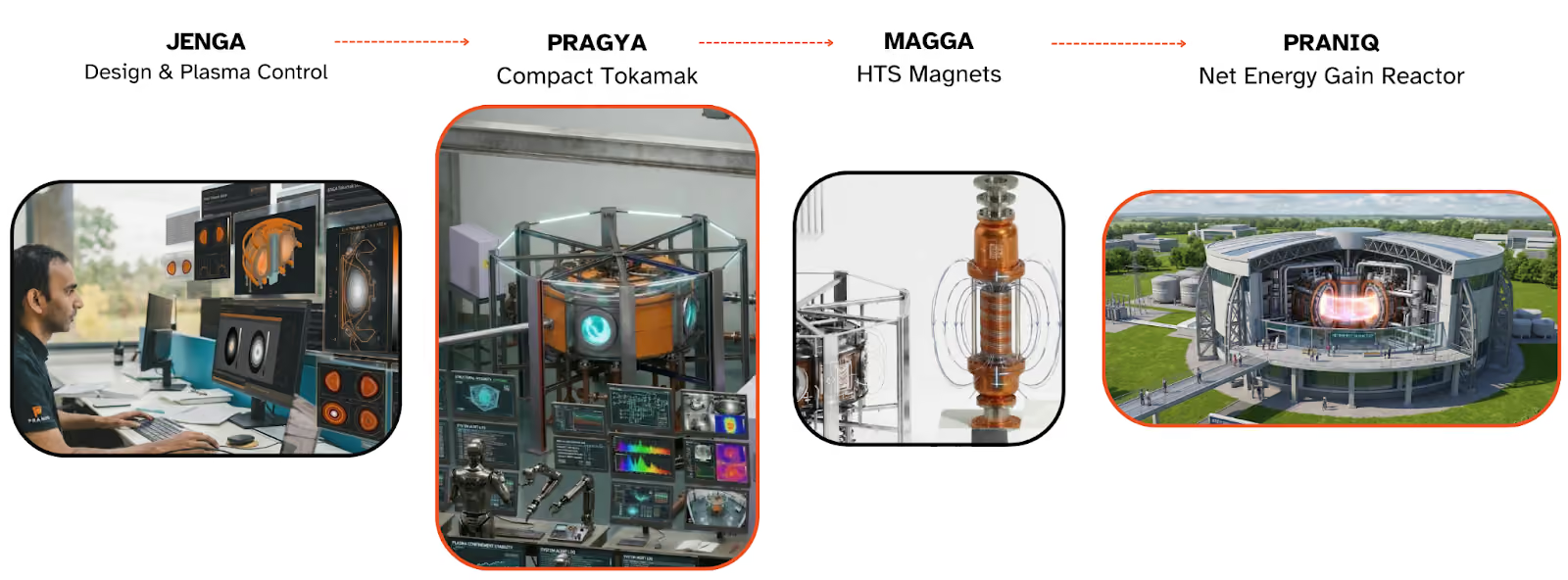
Pranos is also taking a focused developmental approach to accelerate timelines focusing on core tokamak, while allowing specialized partners to integrate downstream subsystems.
Why now: A real fusion inflection point
A combination of technological breakthroughs, changing industry dynamics and policy tailwinds is creating an inflection point for nuclear fusion technology
· Advances in High‑temperature superconductors (HTS)
Maturation of HTS technology is enabling higher magnetic fields in more compact form factors; shrinking reactor size, improving confinement prospects, and making tokamak designs that were previously “lab-only” increasingly buildable.
· Global progress is compressing the barrier to entry
Public programs continue to retire long-horizon physics risk and advance diagnostics, control, and materials know-how. In parallel, private fusion companies have pushed rapid hardware iteration; creating a rich ecosystem of subsystem partners across magnetic systems, plasma control and diagnostics stacks, high-power subsystems, and more.
· Policy momentum and tech sovereignty push
India’s push for energy security and strategic tech autonomy is accelerating regulatory modernization. Reforms such as SHANTI Bill open pathways for private participation with clearer regulatory and liability frameworks. While fusion will ultimately require its own tailored approach, this policy direction signals seriousness about mobilizing industry to be vanguards of India’s nuclear energy aspirations.
Right team for the hard “holy grail” tech
Pranos is founded by Shaurya Kaushal & Roshan George. Shaurya brings deep first-principles modeling and systems intuition while Roshan brings applied AI/ML and a software-and-controls mindset. Together they have assembled a global team with deep expertise in plasma physics, AI, high-power subsystems, cryogenics and superconducting materials.
They’ve moved from research to execution quickly. Pragya demonstrator is stated for operationalization this year, and will provide key design and subsystem validations for PraniQ

At pi Ventures, we back teams building foundational technologies that can bring seismic shifts in core and critical industries. Fusion is a quintessential deeptech challenge that we strive to back: high-barrier, high-impact, and inherently global. Our investment in Pranos aligns with India’s long-term imperative to build sovereign capability in critical energy technologies.
We’re excited to partner with Pranos as they progress from Pragya toward HTS-enabled PraniQ, and to bring the patient capital, strategic inputs needed for this journey.